01 · Reading Guide
Start with the questions that matter.
Examine AI infrastructure demand, cash generation and the durability of system-level economics.

CYRAWAVE REPORT
Original English NVDA research, as of November 1, 2026. Explore eight report chapters and the selected analysis below.
Read the Full NVIDIA Research Example · No sign-in required
Report Showcase 01–08
Switch between sections 01–08 to explore the key questions, specialist perspectives and synthesis.
01 · Reading Guide
Examine AI infrastructure demand, cash generation and the durability of system-level economics.
Identify company questions that need continued testing.
Explain revenue drivers, customer value and competitive constraints.
Read profit, cash flow and capital allocation together.
Explore the assumptions embedded in the price.
Understand trends, volatility, trading volume and relative performance.
Examine how industry, policy, competition and events affect the company.
Preserve supporting and challenging perspectives and their differences.
Synthesize the evidence, retain uncertainty and identify what to monitor next.
Start with a Company You Follow.
Search for Your Company →This is a public product example. Private customer reports are never shown publicly.
Historical research · AI infrastructure
Research as of · Financial baseline: Q2 fiscal 2027, ended July 26, 2026.
This reading edition draws on an existing English CyraWave report. Five specialist perspectives, a Bull/Bear debate and a synthesis examine NVIDIA's business quality and the assumptions needed to sustain it. The research retains its original date; it is not a live market update.
The report understands NVIDIA as more than a GPU supplier. Compute, networking, software and system integration work together in customers' AI infrastructure. Joe's business analysis emphasizes the software ecosystem and the ability to support different workloads, while distinguishing customer and management expectations from demonstrated results. The opportunity depends on customers continuing to deploy and use that infrastructure economically.
For Q2 fiscal 2027, NVIDIA reported revenue of $96.221 billion, up 106% year over year, and a GAAP gross margin of 75.0%. Data Center revenue was about $89.0 billion. The report keeps this market-platform view separate from the statutory Compute & Networking segment; the two classifications should not be substituted for each other. Company Q2 fiscal 2027 results.
Emma's financial analysis distinguishes earnings from cash generation. In the first half of fiscal 2027, operating cash flow was $74.421 billion and capital expenditure was $4.434 billion, giving conventional free cash flow of $69.987 billion. Net income of $118.010 billion included substantial investment-related effects. The analysis treats equity-security gains and working-capital expansion as important to understanding the gap, rather than assuming all reported earnings represent recurring operating cash. Q2 fiscal 2027 Form 10-Q, financial statements.
The constructive case combines the CUDA software ecosystem, workload flexibility and the coordination of compute, networking and software. Customers are buying a usable system, not just a component benchmark. The original research sees those connections as an important defense against substitution, while leaving open how much pricing power and margin they can preserve as alternatives mature.
The report highlights demand durability, customer economics, competing architectures, export restrictions and execution across a rapidly expanding supply chain. It also examines inventory, receivables, investments and supply commitments. These exposures are different from current debt or recognized losses: their significance depends on demand, counterparties and future execution. Company disclosures and risk factors.
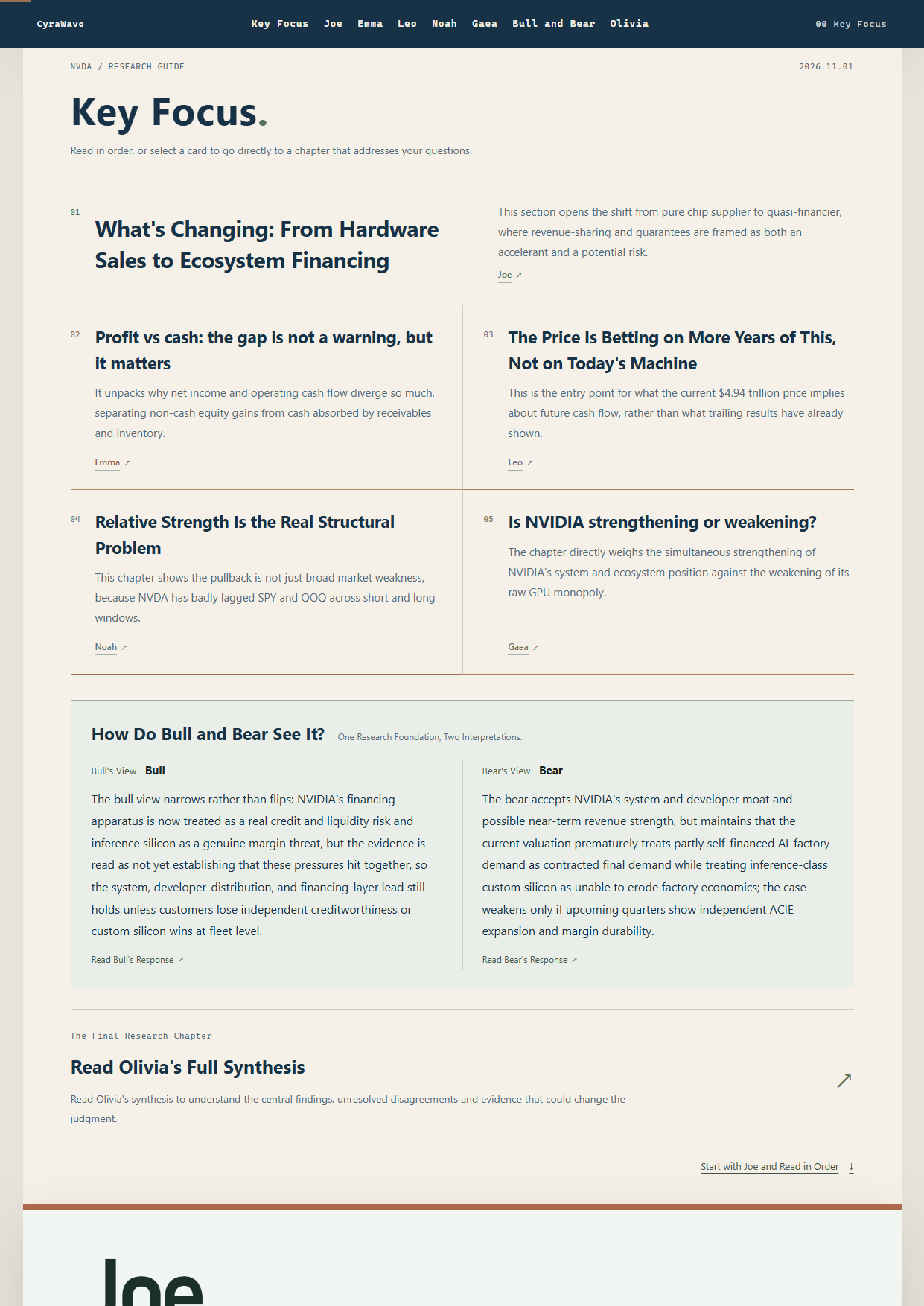
Joe examines the business mechanism; Emma separates earnings, cash and capital commitments; Leo asks what future performance the valuation requires; Noah examines dated market structure; and Gaea considers the external competitive environment. Bull and Bear test different interpretations before Olivia brings the evidence together. Their disagreement is useful: a strong present business does not settle the duration of future returns.
The November 1 synthesis gives greater weight to the cautious interpretation of valuation and durability, while accepting the strength of the operating franchise. It argues that integrated-system advantages must ultimately be supported by durable customer demand and margins. It does not conclude that NVIDIA is weak, that leadership will disappear or that the next quarter must disappoint. Claims about particular competing products are not reproduced here as independently established facts.
The report's follow-up questions concern customer utilization and economics, the persistence of system-level margins, conversion of earnings into cash, and the relationship between supply commitments and end demand. Stronger evidence on these points would support the constructive case. Weaker customer economics or deteriorating cash conversion would challenge it. These are research questions, not price targets or trading instructions.
The company release and SEC filing support the financial facts. The analytical interpretations are selected from CyraWave's existing report, not newly generated research. All periods and reporting measures retain their original meaning. Chapter images show the original historical report; this selected reading edition is not a claim that every statement in the complete report has been independently verified.
For general research and information only. Not personalized investment advice or a recommendation to buy, sell or hold. Historical findings may no longer describe current conditions. Disclaimer.